Catalonia is one of Europe’s ‘hidden’ regions.
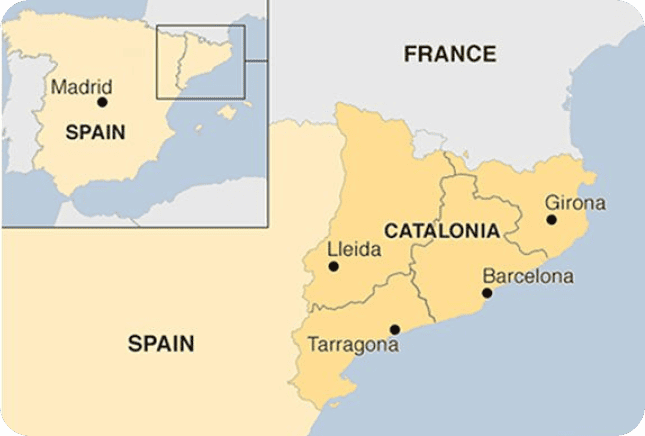
Located in northeastern Spain, Catalonia shares borders with France and Andorra in the north and the Mediterranean Sea to the East. It extends down towards the autonomous communities of Valencia in the south and Aragon in the west.
Barcelona is Catalonia’s capital and only a 55 minute train ride away from our office.
It’s one of Europe’s – if not the world’s – most hyped cities, but we just can’t fault Barcelona. The sun-drenched, beachside regional capital boasts vibrant markets, street performers, awesome architecture, world-class restaurants, astonishing art and nightlife to keep you entertained ’til dawn. It epitomises the Spanish good life, managing to be both packed with excitement yet laid back and Mediterranean.
About 40 minutes north of Barcelona is the city of Girona, our provincial capital.
Those who penetrate the walls of ancient Girona will find a city with plenty of charm – and none of Barcelona’s crowds. The Medieval Quarter is actually a relatively “modern” district – parts of Girona date back to Roman times. The Jewish Quarter is one of the most picturesque; visit the Ramblas, market places and cafes for a true taste of urban Catalonia.
Despite just being one region, Catalonia’s landscapes range from 3,000m-high Pyrenean peaks, to the warm, turquoise waters of the Mediterranean, passing plateaus, forests, rice paddies and ravines along the way. You can ski and sunbathe in the same day, while cyclists and hikers can spend each day travelling through an entirely new backdrop, from wildflower meadows to mountaintop monasteries.
With its lush vegetation propped against the blue and green immensity of the sea and the majestic mountains of the high Pyrenees, Catalonia is a place of rare beauty.
And if nature’s splendor isn’t enough, you’ll find historic remnants, churches, and archaeological sites that will leave you even more in awe.
The region’s curiousness perhaps explains the fantastical minds of its most famous offspring – Salvador Dalí and Antoni Gaudí, whose influences run strong in the cities, parks and galleries. Barcelona may bask in all the glory, but those in the know come to Catalonia for the landscapes.
The eastern end of the Pyrenees creep into Catalonia, providing a frequently snow-capped backdrop to this region’s already marvelous scenery. The Catalan Pyrenees boast lush valleys, dense forests, and rugged mountain peaks, offering stunning views in all directions. Winding rivers and ancient alpine towns are scattered throughout, making this area a paradise for nature lovers and hikers.
We totally rate the Costa Brava, though perhaps not in the way you would think… Despite the name, the “Costa” covers a lot more than the coast, and while the parts bathed by the Mediterranean are perhaps the best known, it’s the inland treasures that keep travelers coming back for more. Even in the height of summer you only need to walk a short distance to get away from the beachside sunbathers, and into another world entirely.

Any worthy travel book must include a mention of gastronomy. The Catalan cuisine is one of the most prestigious in the world. Internationally famous chefs such as Ferran Adrià, Carme Ruscalleda and the Roca brothers come from here. All have been fundamentally influenced by the country’s traditional gastronomy based on fresh and local produce. This gastronomic intensity gives visitors the exciting opportunity to explore the wonderful depth and flavours of Catalan cuisine.
Mar i muntanya – sea and mountain – is the key to Catalan cuisine. Mussel farms and fishing boats capture the essence of the ocean; the fertile soil nurtures vineyards, olive groves, rice paddies and wild herbs; and the sausages, baked lamb and succulent chicken will delight carnivores. Even better, everyone is so keen to share the fruits of their land that your plate will be filled again – and each dish will have its own story.
Catalonia has always sat rather uncomfortably on Spain’s north-eastern tip, yet never fully managed to break away. After centuries of being controlled by a central Spanish government, who used this region for their own ends, a Catalan Republic was finally declared again in 1931, though it was short-lived. The Spanish Civil War began in 1936, and as Catalonia held out against the Republicans, they were punished in the ensuing decades of Franco’s dictatorship with the suppression of their language, dance and other cultural traditions. Franco even tried to water down the local culture by encouraging immigration from across Spain, but in testament to the strength of the Catalan character, the spirit survived.
Following Generalísimo’s death and the return to democracy, Catalonia was once again granted autonomy and Catalan was recognised as one of the national languages of Spain. The years of persecution have no doubt heightened their sense of patriotism, and the sardana dance, local cuisine and other Catalan traits are celebrated across the region almost continually from spring to autumn; even the tiniest of villages will stage two or three annual ferias.
There has always been talk of full independence, and local support for this increased during Spain’s economic crisis from around a third to half the population. Catalonia is both the richest and most indebted region, and it grew increasingly unhappy by the pressures placed upon it by Madrid. In 2013, over one and a half million people formed a human chain stretching 400km from the mountains to the sea in support of independence although over the last year the drive for independence has deteriorated with the latest poll results showing that only 42% of the population now want independence and that number is likely to drop over the coming months.
Catalan culture is a vibrant blend of traditions, languages, and artistic expressions rooted in the region’s rich history. The people of Catalonia take pride in their distinct identity, which is reflected in their language, Catalan, and their strong sense of community. Celebrations like the human towers (“castells”) and the lively Sardana dance are central to Catalan life. Needless to say, Catalans are proud of their heritage and traditions, and offer a warm welcome to foreign visitors.
There are countless ways to enjoy the nature that Catalonia has to offer. Our favorites are walking and cycling.
Walking in Catalonia means undulating but gentle paths through unspoilt coastline, deep-green farmland, orchards, olive groves and vineyards that welcome you in for a tasting. Closer to the Pyrenees the terrain grows steeper rewarding with sublime views. Our walking holidays in Catalonia are enormously diverse, always inspiring you to see what lies beyond the next bend in the trail.
One of the best road biking spots in the world, Catalonia frequently plays host to international teams who come to train in its varied terrain. But novices shouldn’t be put off; there are plateaus and the perfectly flat Ebro Delta, as well as the Greenways – dedicated trails along the paths of old railroads. It’s the perfect way to immerse yourself in the rhythms of Catalonia’s local and rural life.
Catalonia is a wonderfully warm region of Europe. It has a Mediterranean climate with hot, dry summers and mild winters with irregular rainfall. If there is one feature characteristic of the Catalonian region, it is the light, a direct result of the great number of hours of sunlight, which marks the cheerful nature and hospitality of the locals.
Walkers and cyclists will appreciate the cool of spring. Even in midsummer, the Mediterranean and Pyrenees provide a refreshing breeze, meaning it is not as insufferable as arid Andalucia. Catalonia is also a fantastic place for winter sun, without the bitter cold of central Spain or the rainclouds of the northwest. Autumn too is pleasant, without the summer heat or crowds.
Catalan Adventures